Claude Fable 5.2 Guide: Pricing, Benchmarks and When It Beats Opus 5.5


Executive Summary
- What shipped: Anthropic released Claude Fable 5.2 and Claude Mythos 5.2 on November 9, 2026. They are the same underlying model. Fable has cyber and biology safeguards and is open to everyone, while Mythos is limited to verified organizations.
- Price: $8 per million input tokens and $40 per million output tokens, down 20% from Fable 5.1. An optional fast mode costs $16/$80.
- Performance: Anthropic reports wins over Opus 5.5 on most of its tests, and Vals AI ranks it first of 36 models on its independent index, by a narrow margin.
- Default choice: Anthropic still recommends starting most work on Opus 5.5 and moving up to Fable for the most ambitious technical work.
- Migration: The model ID swap is easy, but four breaking changes can return 400 errors or drop reasoning. The biggest one affects any agent that edits its conversation history.
This guide covers what each of those points means in practice. If you are coming from the previous release, my Fable 5.1 breakdown has the background on preserved thinking and forced tool use.
Claude Fable 5.2 specs at a glance
- API model ID:
claude-fable-5-2, oranthropic.claude-fable-5-2on Amazon Bedrock - Context window: 1M tokens, with 128K max output
- Input and output: Text and images in, text out
- Thinking: Adaptive, always on
- Effort levels:
low,medium,high,xhighandmax - Default effort:
highon the API, but Medium in Claude apps and Claude Code - Knowledge cutoff: June 2026
- Speed: Up to 30% faster output than Fable 5.1
- Retirement: Not before November 9, 2027
- Platforms: Claude API, Bedrock, Claude Platform on AWS, Google Cloud and Microsoft Foundry
Fable 5.2 pricing, and what a task really costs
Here is the official rate card, per million tokens:
- Input: $8 (Fable 5.1 was $10, Opus 5.5 is $4)
- Output: $40 (Fable 5.1 was $50, Opus 5.5 is $20)
- 5-minute cache write: $10
- 1-hour cache write: $16
- Cache read: $0.20, the same as Opus 5.5
- Batch API: $4 input and $20 output
There is no long-context premium, so the full 1M window bills at standard rates. Keep that in mind against GPT-6 Astra, which charges $20/$75 above 272K input tokens.
The cache-read detail most comparisons miss
Fable costs twice as much as Opus 5.5 on fresh tokens, yet both charge $0.20 for cache reads. So the premium shrinks as a session grows. Two examples, calculated from the list prices above:
A single large request with 100K fresh input tokens and 20K output tokens:
- Sonnet 5.5: $0.40
- Opus 5.5: $0.80
- Fable 5.2: $1.60
- Fable 5.1: $2.00
- Fable 5.2 in fast mode: $3.20
One turn of a long agent session with 500K cached tokens, 5K fresh input tokens and 5K output tokens:
- Sonnet 5.5: $0.11
- Opus 5.5: $0.22
- Fable 5.2: $0.34
In the second case, Fable costs about 1.55 times as much as Opus 5.5, not 2 times. Real runs will also include cache writes and thinking tokens, so treat these as a starting point and measure your own workload.
Cost per task can favor Fable
Anthropic's launch comparisons show why the per-token price is only part of the picture:
- FrontierCode 2.0: Fable 5.2 at High scores 45.3%, against 45.5% for Opus 5.5 at its best, for roughly half the cost per task.
- WANDR: Fable 5.2 at Medium matches Opus 5.5's top score for about 40% of the cost per task.
- Humanity's Last Exam: Fable 5.2 at Low matches Opus 5.5's top score for less than a tenth of the cost per task.
These compare Fable at a moderate effort with Opus at its maximum. They do not show that Fable is cheaper than Opus at the same effort, so run the sweep on your own tasks.
When fast mode is worth it
Fast mode speeds up token generation by up to 2.5 times at double the price. It suits interactive work where someone is waiting. Three limits matter:
- The gain is in output tokens per second, not time to first token.
- It doesn't work with the Batch API or a Priority Tier commitment.
- Falling back to standard speed causes a prompt cache miss, because the two speeds don't share cached prefixes.
response = client.messages.create(
    model="claude-fable-5-2",
    max_tokens=16000,
    speed="fast",
    messages=[{"role": "user", "content": "Review this diff."}],
)

print(response.usage.speed)  # "fast" or "standard"
On Microsoft Foundry, fast mode is a separate model called claude-fable-5-2-fast, so omit speed there.
Fable 5.2 benchmarks
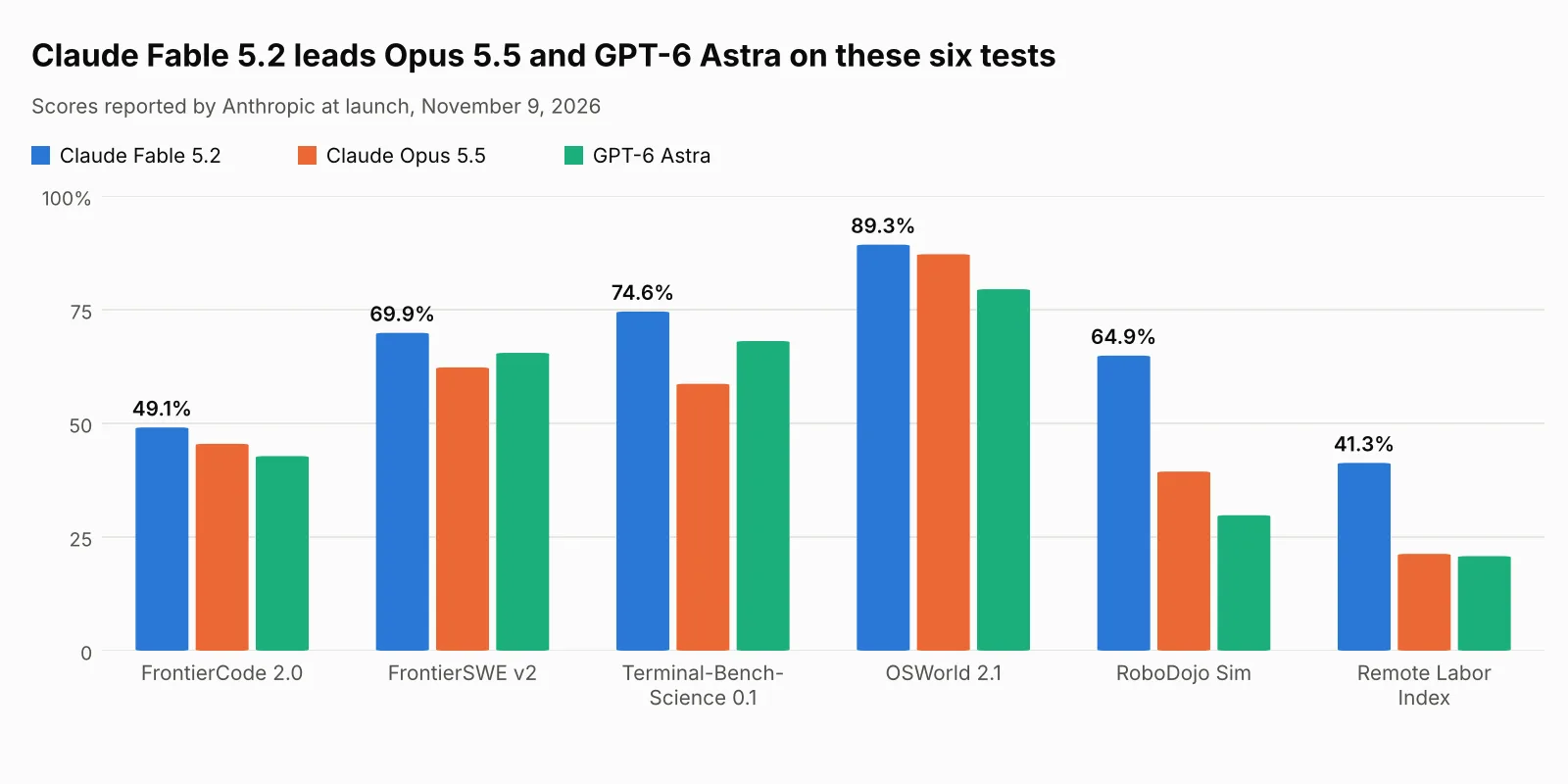
Grouped bar chart comparing Claude Fable 5.2, Claude Opus 5.5 and GPT-6 Astra on six Anthropic-reported benchmarks. Fable 5.2 leads all six.
The full figures below come from Anthropic's launch table, in the order Fable 5.2, Fable 5.1, Opus 5.5, GPT-6 Astra:
- FrontierCode 2.0 (agentic coding): 49.1%, 32.4%, 45.5%, 42.8%
- FrontierSWE v2 (agentic coding): 69.9%, 56.3%, 62.3%, 65.5%
- Terminal-Bench-Science 0.1: 74.6%, 52.6%, 58.7%, 68.1%
- OSWorld 2.1 (computer use): 89.3%, 83.5%, 87.2%, 79.5%
- RoboDojo Sim (robotics, run by Anthropic): 64.9%, 27.6%, 39.4%, 29.8%
- Remote Labor Index (Fable 5.2 at High effort): 41.3%, 17.9%, 21.3%, 20.8%
- Humanity's Last Exam, with tools: 74.2%, 65.6%, 67.7%, 57.2%
- AutomationBench (business workflows): 51.4%, 31.4%, 42.5%, 41.4%
- AA-Briefcase v1.1, rubric: 66.1%, 61.5%, 61.2%, 52.0%
- AA-Briefcase v1.1, Elo: 1785, 1669, 1800, 1569
The biggest jumps are in robotics and remote knowledge work. RoboDojo and the Remote Labor Index both land at more than double Fable 5.1's score.
Fable doesn't win everything. Gemini 4 Carbon scores 53.9% on AutomationBench, ahead of Fable's 51.4%, and Opus 5.5 keeps a small lead on AA-Briefcase Elo.
What independent testing shows
Vals AI tested Fable 5.2 at High effort and gives a useful second view:
- Vals Index: 71.31%, first of 36, at $17.94 per test. Sonnet 5.5 is close behind at 70.85%, at a far lower token price.
- First place: Finance Agent v2.1, Vibe Code Bench, EMB v1.1 and BioMysteryBench.
- Weaker spots: Legal work ranks 20th of 37, and Tax Agent Bench ranks 27th of 84.
- Behind Opus 5.5: SWE-bench Multimodal, at 62.29% against 70.21%.
- Behind GPT-6 Astra: Vals Science Index, at 63.74% against 65.09%.
Treat the launch table as Anthropic's own results. Anthropic notes that the external organizations involved did not review its post or system card.
Fable 5.2 vs Opus 5.5: which should you use?
Start with Opus 5.5, as Anthropic recommends. Then move only the work that justifies it.
Choose Fable 5.2 when:
- A task runs for hours and earlier attempts stalled or drifted
- The problem is open-ended, and Opus 5.5 fails your evaluation even at high effort
- You need one model to coordinate others, as an orchestrator or an advisor
- The work involves robotics, hardware design or scientific computing, where its reported lead over Opus 5.5 is large
Stay on Opus 5.5 or Sonnet 5.5 when:
- Your evaluations already pass on the cheaper model
- You need zero data retention and aren't authorized for it on Fable
- Your work touches security testing or research biology, which Fable's safeguards block
- The job is short and high-volume. My Sonnet 5.5 guide covers that tier
Choosing an effort level
Anthropic's prompting guide maps effort to workload:
low: Quick, well-specified tasks and high-volume subagentsmedium: Interactive coding, chat and everyday knowledge workhigh: Hard coding, research, agentic work and long unattended runsxhigh: The hardest long-running work, only where you've measured a gainmax: Measuring the ceiling, or problems where time and tokens don't matter
At xhigh and max, the model may start subagents to review its own work, which can become a large share of session cost.
Fable 5.2 vs GPT-6 Astra
Fable 5.2 is now cheaper than GPT-6 Astra, which lists at $10/$50. It also leads Astra on every row of Anthropic's table where both have a score.
That table comes from one vendor, so test both on your own tasks if you're choosing between them. Vals' Science Index is one independent result where Astra is ahead.
How to migrate to Claude Fable 5.2
Four breaking changes from Fable 5.1
- The prefix check now applies to every account. Changing
system,toolsor an earlier message before a thinking block returns a 400 error. On Fable 5.1, this only hit accounts created on or after August 31, 2026. - Thinking blocks stay with the model that made them. Moving to another model drops that reasoning, including Fable 5.1, Opus 5.5 and the fallback models.
computer_20251124is gone on every platform except Bedrock. Usecomputer_toolset_20260801.- Advisor pairing is stricter. A Fable 5.2 executor accepts only a Fable 5.2 or Mythos 5.2 advisor.
The first change is the one to test first. If your agent rebuilds messages itself, run a test session with drop_block, log every mismatch, and fix them before production:
{
  "model": "claude-fable-5-2",
  "thinking": {
    "type": "adaptive",
    "block_binding": { "prefix_mismatch_behavior": "drop_block" }
  }
}
That setting needs the thinking-binding-controls-2026-08-01 beta header. Treat it as a diagnostic, since dropping blocks can raise output tokens.
Extra steps if you're coming from Opus 5.5
- Enable 30-day retention first. Otherwise requests return a 400 error, unless Anthropic has authorized zero retention.
- Set
effortexplicitly. Fable defaults tohigh, while Opus 5.5 defaults tomedium, so omitting it runs one level higher. - Replace forced tool calls.
tool_choiceofanyortoolreturns a 400 error. Useautowithstrict: truetools, or JSON outputs. - Remove
thinking: {type: "disabled"}, prefill and sampling parameters. - Read content blocks by
type, becausethinkingblocks now come first. - Leave room for thinking in
max_tokens. A small value can end the response before any text.
response = client.messages.create(
    model="claude-fable-5-2",
    max_tokens=16000,
    output_config={"effort": "high"},  # set this explicitly
    messages=history,  # append-only, returned exactly as received
)

if response.stop_reason == "refusal":
    log_refusal(response.stop_details.category)  # for example "cyber" or "bio"
Migration checklist
- Update the model ID in a test environment.
- Check rate limits. Fable 5.2 has its own limit, separate from Fable 5.1 and Fable 5.
- Freeze
systemandtoolsfor the session, and keepmessagesappend-only. - Return thinking blocks unchanged, including empty ones.
- Replace the old computer-use tool and update advisor models.
- Handle every
stop_details.category. - Confirm you don't rely on Priority Tier, which isn't supported.
- Re-run your effort sweep and re-baseline cost and latency.
How to get better results from Fable 5.2
The prompting guide has several findings worth applying right away.
Stop telling it not to think. Prompts that ask for an answer without deliberation don't stop thinking at medium and above. Lower the effort level for easy turns instead.
Tell it to finish the job. Turns can end early on long tasks, especially at low and medium. Anthropic's recommended system prompt roughly halved sessions that ended with doable work left, at about 30% more output tokens. Use the full version from the guide, or start with a short one like this:
Finish the whole task before you stop. Work through ordinary errors and timeouts.
Stop only for a decision you need from me, a deliberate block, or a risky action that needs approval.
State who owns the code. Without ownership wording, the model tends to add to existing structure and report nearby problems instead of fixing them. Telling it the codebase is its to shape led it to merge repeated code in about half of tries, against under a tenth without. It also used about 1.5 times the output tokens, so review the diff and leave this out when you want minimal changes.
Be exact about approvals. The model applies approval rules literally, so name the action you're approving.
Audit old prompts. Remove lines written for earlier models, including any that ask the model to write its reasoning into the response, since those can trigger a reasoning_extraction refusal.
Using Fable 5.2 in Claude Code
Update first, then select the model by its full ID:
claude update
claude --model claude-fable-5-2 --effort medium
The full ID is the safe option today, because the Claude Code model docs still described the fable alias as Fable 5.1 when this was written. Inside a session, you can use /model claude-fable-5-2 and /effort high.
Watch your subagents. Those without a model setting inherit the main conversation's model, so switching to Fable can move all of them to Fable pricing too.
Anthropic lists Claude Code among the fast mode surfaces, but the Claude Code fast mode page still covered only Opus models at the time of writing, so confirm with /fast on your version.
Launch offer: Pro plans and standard Team seats can use Fable models for up to 50% of their weekly limits through November 16, plus one reset. Max, Ultra and premium seats get one to three resets, depending on how long they've subscribed.
Fable 5.2 vs Mythos 5.2: safeguards and access
Fable's classifiers block high-risk cyber activity such as penetration testing, exploit generation and binary-based vulnerability work, plus most research biology tasks. Blocked cyber queries get an answer from Opus 4.8, and blocked biology queries get one from Opus 5.
The good news is that blocks are down about 55% overall from Fable 5.1, including about 60% in cybersecurity and 40% in biology. On the API, refusals return HTTP 200 with stop_reason: "refusal", and the beta fallbacks: "default" option can retry on the recommended model.
Mythos 5.2 is Anthropic's most capable model for cybersecurity engineering. It found 10.2% more vulnerabilities than Opus 5.5 on Anthropic's CVE Rediscovery test, and Mozilla reports it roughly doubled Mythos 5.1's vulnerability discovery metrics on Firefox.
There are three ways to reach its capabilities:
- Cyber Verification Program: Apply through the Verification Portal. Organizations apply once, and independent researchers, maintainers and bug bounty hunters apply as individuals.
- Life Sciences Verification Program: For biology researchers.
- Claude Security: Available to Claude Enterprise customers, even outside the verification program.
Confirm regional eligibility before you plan around Mythos, because I couldn't find a published country list for 5.2. Both models require 30-day data retention by default. Enterprise Frontier Safeguards, which runs safety monitoring on data stored in the customer's own infrastructure, is in private beta.
What to keep in mind
- Testing is getting harder. Anthropic says both models voice suspicion that they're being evaluated more often than any recent model, which makes real-world behavior harder to predict.
- Developer reaction is mixed. The Hacker News thread welcomed the price cut and speed, but also questioned how comparable the benchmarks are and whether launch-week performance will last.
- The showcase results are Anthropic's own. The eight-day operating system build and the Fermat's Last Theorem formalization came from Anthropic's own experiments, so they don't predict your results.
- Agents still need limits. Long runs need permission boundaries, logging and human review, whichever model you pick.
Frequently asked questions
What is Claude Fable 5.2?
It is Anthropic's model for demanding reasoning and long-running agent work, released on November 9, 2026, and a step up from Opus 5.5 in Anthropic's lineup.
How much does Claude Fable 5.2 cost?
$8 per million input tokens and $40 per million output tokens. Fast mode is $16/$80, and the Batch API is half the standard rate.
Is Fable 5.2 better than Opus 5.5?
On most of Anthropic's benchmarks, yes. Opus 5.5 costs half as much per token and remains Anthropic's recommended starting point for most work.
Why is Fable 5.2 numbered lower than Opus 5.5?
Fable and Opus are separate lines with their own version numbers. Anthropic positions Fable above Opus 5.5 despite the lower number, and The New Stack also noted the surprise that it wasn't called 5.5.
What is the difference between Fable 5.2 and Mythos 5.2?
They're the same underlying model. Mythos has fewer cyber and biology restrictions and is only for verified organizations, at the same specs and price.
Can I use Fable 5.2 for penetration testing?
Generally no. Its safeguards block penetration testing and exploit generation. Authorized security teams should apply to the Cyber Verification Program.
Is migrating from Fable 5.1 just a model ID change?
That's the core change, but test the prefix check, computer-use tool, advisor models and rate limits before you ship.
Sources
- Anthropic: Claude Fable 5.2 and Mythos 5.2
- Claude Fable 5.2 overview
- What's new in Claude Fable 5.2
- Claude Fable 5.2 migration guide
- Prompting Claude Fable 5.2
- Claude API pricing
- Fast mode on the Claude API
- Claude Code model configuration
- Claude Code fast mode
- Claude Mythos
- Cyber Verification Program
- Claude Fable 5.2 launch offers
- Vals AI: Claude Fable 5.2
- The New Stack: Fable 5.2 launch
- TechCrunch: New Mythos and Fable models
- Yotta Labs: GPT-6 Astra pricing
- Hacker News discussion
Comments
Share your thoughts and join the conversation
Leave a Comment
Keep reading.
Node.js HIGH Severity Release Due Nov 11, Elysia 2.0 RC4: Dev Stack Release Audit, November 9, 2026

Copilot Lands in Xcode, Claude Code Tightens Auto Mode, Codex Adds an Agent Command Center