
StatusDock
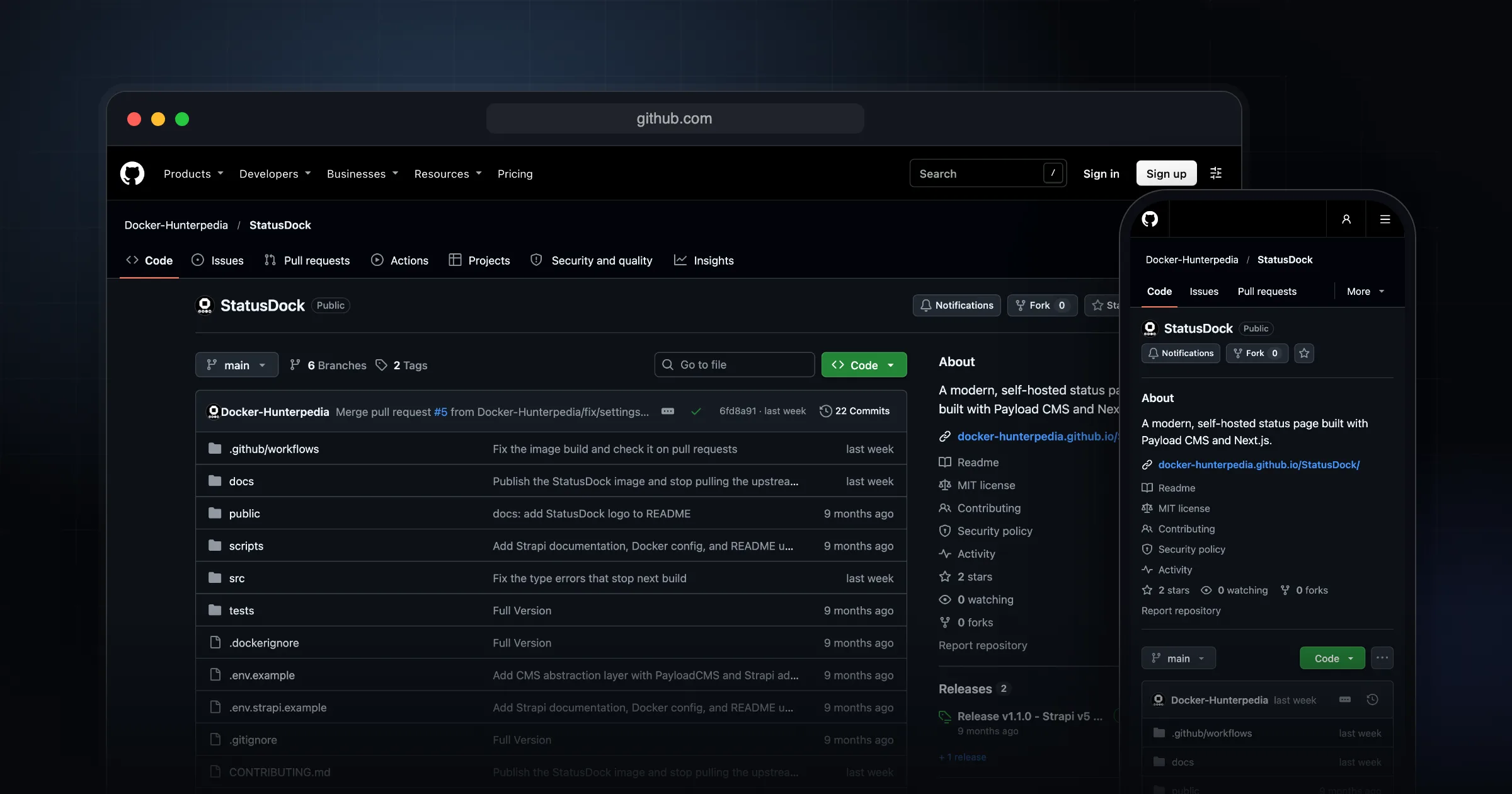
StatusDock is a free, open-source status page I built for teams that want to host it themselves. It covers incidents, scheduled maintenance, and email and SMS notifications to subscribers, runs on Next.js with Payload CMS or Strapi, and ships as a Docker image for amd64 and arm64.
What it does well.
Incident timelines with severity stages
Scheduled and recurring maintenance windows
Email (SMTP) and SMS (Twilio) notifications
Notification drafts you review before sending
Service groups with per-service history
Public incident history page
Dark mode and custom branding
REST API
Payload CMS 3 or Strapi v5 admin
Docker image for amd64 and arm64
Why I recommend this.
StatusDock is an excellent choice if you operate any service that others rely on and want full control over your status and incident communications. Because it’s built with Next.js and Payload CMS, you get a modern, performant stack plus a flexible content model that’s easy to customize and extend.
The core value of StatusDock is that it gives you a polished, professional status page with:
- Incident tracking – Log, categorize, and update incidents so users can see what’s happening and how it’s progressing.
Why I built StatusDock
Hosted status pages charge per month, and often per subscriber, for what is mostly a page of service states and a list of incidents. I wanted one I could run next to my other services, with the data in my own PostgreSQL database, so I built StatusDock and released it under the MIT licence.
Who it is for
StatusDock suits small teams, agencies and SaaS products that want a public status page on their own domain without a subscription. It also fits teams that already self-host with Docker and want the status page on the same infrastructure, and developers who want to change the code rather than work around a hosted product's limits.
What it does
- Services grouped into categories, each with a live status and its own incident history.
- Incidents with timeline updates, a severity stage (investigating, identified, monitoring, resolved) and links to the affected services.
- Scheduled maintenance windows, including recurring ones, with notices to subscribers before they start.
- Email notifications over SMTP and SMS through Twilio, with editable templates and per-service subscriptions.
- A public incident history page, dark mode, custom branding and a REST API.
- An admin panel powered by Payload CMS 3, or Strapi v5 if you prefer it as the backend.
How notifications work
Notifications are never sent on their own. When you create or update an incident or maintenance window, StatusDock prepares a notification draft, and you review and send it from the admin panel. That keeps a half-written update from reaching every subscriber.
Self-hosting with Docker
StatusDock ships as a multi-architecture image for amd64 and arm64 at ghcr.io/docker-hunterpedia/statusdock, built from the repository on every release. The quickest start is the included Docker Compose file, which runs the app and PostgreSQL 16 together:
- Clone the repository and run docker compose up -d.
- Set POSTGRES_PASSWORD, PAYLOAD_SECRET and SERVER_URL in your environment before going to production instead of relying on the defaults.
- Open http://localhost:3000 for the status page and /admin to create the first admin account.
- Follow the Docker Compose guide for a production setup behind a reverse proxy.
There is also a one-click Vercel deploy that provisions Postgres and Blob storage, and full build-from-source steps in the installation guide.
Tech stack
Next.js 15 with the App Router, React 19, TypeScript, Payload CMS 3 (or Strapi v5), PostgreSQL 16+, Tailwind CSS, the Lexical rich-text editor, Nodemailer for email, Twilio for SMS, and Playwright for end-to-end tests.
Limitations
StatusDock is a status page, not an uptime monitor. It does not ping your services, so a status changes when you open an incident, schedule maintenance or edit a service. If you want automatic checks, pair it with a monitor such as Uptime Kuma and update StatusDock from there. You also own the hosting, backups and email deliverability, as with any self-hosted tool.
StatusDock vs. alternatives
- Atlassian Statuspage and other hosted pages: nothing to run, but a monthly bill and your data on someone else's platform.
- Uptime Kuma: excellent automatic monitoring with simple status pages, but lighter on incident write-ups and subscriber notifications.
- Cachet: a long-standing open-source status page in PHP; StatusDock is the choice if you want a Next.js and TypeScript codebase.
Getting started checklist
- Run the Docker Compose quick start locally and create your admin account.
- Add your service groups and services, and set your branding.
- Configure SMTP (and Twilio if you want SMS), then send yourself a test notification.
- Deploy behind HTTPS on a status subdomain and link it from your site and app.
- Read the admin guide for incident and maintenance workflows.
Comments
Share your thoughts and join the conversation